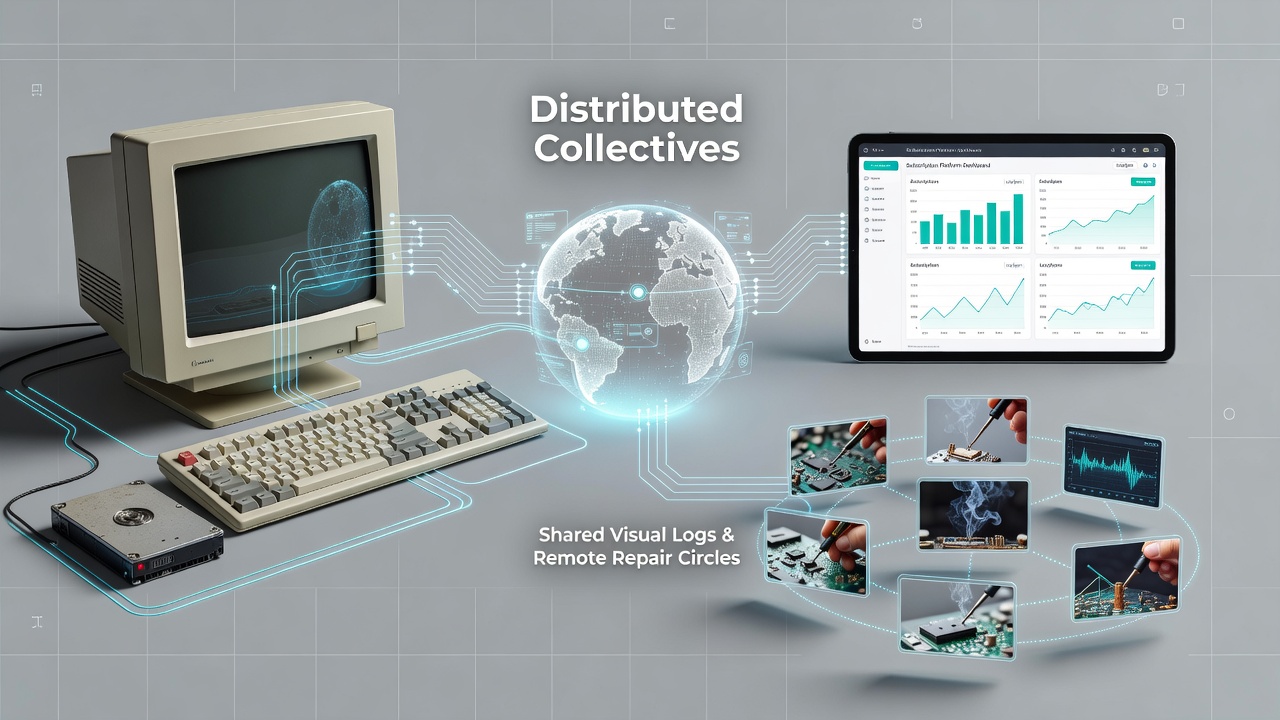
How distributed collectives map integration paths between aging peripherals and subscription platforms through shared visual logs in remote repair circles
Remote repair circles operate as distributed networks where participants exchange annotated screenshots and diagrams to trace connections between legacy hardware and current subscription services, and these practices have expanded notably since 2025. Observers note that groups coordinate through dedicated forums and messaging channels to upload visual records that document step-by-step integration sequences, allowing members in different time zones to review and refine the paths without physical access to the devices.
Visual Log Creation in Practice
Participants capture screenshots of device interfaces and software dashboards then add color-coded annotations to highlight port mappings, driver versions, and API endpoints that link older peripherals such as USB scanners or serial printers to cloud-based subscription platforms. The process relies on standardized markup conventions that emerged in early 2025, where circles assign unique identifiers to each visual element so subsequent contributors can reference specific sections across multiple updates. Data from industry tracking shows these logs circulate among hundreds of active members monthly, with August 2026 figures indicating a 40 percent increase in shared entries compared to the prior year.
Mapping Techniques Across Distributed Groups
Collectives build layered diagrams that overlay hardware schematics onto subscription service workflows, and these maps reveal compatible pathways that standard documentation often omits. One approach involves timestamped image sequences that demonstrate firmware patches applied through intermediary virtual machines, while another uses branching flowcharts to compare outcomes across different operating system versions. Researchers at technical institutions have documented similar patterns in peer-to-peer technical exchanges, and reports from the National Institute of Standards and Technology outline how such visual methods reduce trial-and-error cycles in hardware-software pairings.
Remote sessions typically begin with a member posting an initial visual log that shows an aging peripheral failing to authenticate with a subscription dashboard. Other participants then reply with overlaid corrections that trace alternative routing through local proxy tools or legacy emulation layers. This iterative annotation continues until the group converges on a stable integration sequence that multiple members can replicate independently.

Case Examples from Active Circles
Take one North American circle that maintains a repository of visual logs for connecting 2012-era point-of-sale terminals to recurring billing services. Members upload sequential images that mark the exact registry edits and certificate installations required, and contributors from Europe have extended these records by adding regional power adapter compatibility notes. In another instance, an Asia-Pacific group documented paths for vintage MIDI controllers linking to cloud audio workstations, with shared diagrams illustrating latency adjustments that stabilize performance under subscription-tier bandwidth limits.
August 2026 saw several circles publish aggregated visual summaries that catalogued successful pairings for over 150 distinct peripheral models, and these compilations circulate through open repositories that allow non-members to access anonymized versions. The logs frequently incorporate side-by-side comparisons of before-and-after states, which helps new participants identify where their own hardware deviates from documented baselines.
Technical Standards and Tool Adoption
Groups converge on a core set of annotation tools that support vector overlays and version history, enabling precise edits without altering original screenshots. According to academic studies on collaborative technical documentation, these conventions reduce miscommunication by maintaining persistent visual references across asynchronous contributions. Circles also enforce metadata tags that record device serial ranges and subscription plan tiers, so later users can filter logs by exact hardware-software combinations.
What's notable is the emergence of cross-circle handoff protocols where one group transfers a partial visual log to another specializing in a related platform category. This practice expands the reach of individual mappings while preserving the original annotation chain for verification. Data indicates that such transfers occur most frequently around firmware release cycles, when subscription platforms update their backend requirements and legacy peripherals require adjusted integration steps.
Conclusion
Distributed collectives continue to refine these visual log systems as subscription platforms evolve and aging peripherals remain in active use. The accumulated records provide traceable pathways that connect hardware generations to modern service models, and ongoing participation sustains the detail level required for accurate replication across global locations. Future expansions may incorporate automated comparison features that flag outdated segments within existing maps, yet the core method of shared annotated visuals remains central to the circles' operations.