
Mapping Configuration Exchanges Among Niche User Groups and Their Effects on Extending Gadget Integration Within Specialized Productivity Platforms
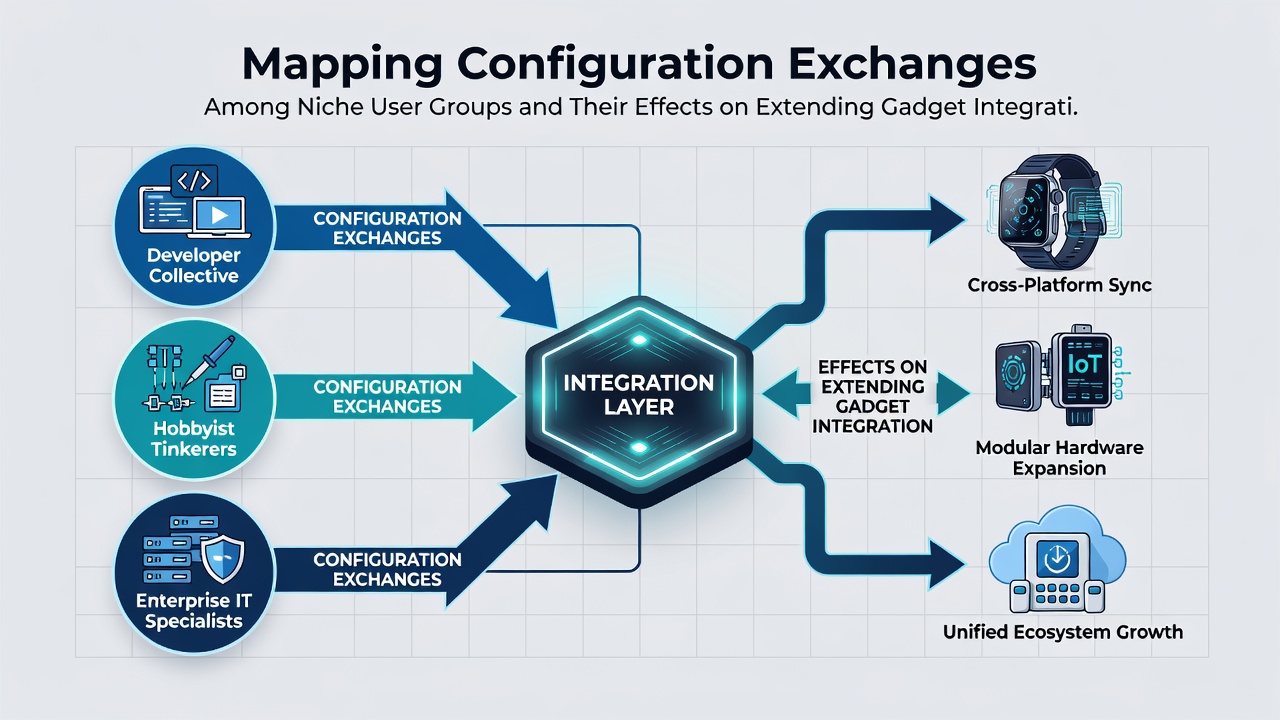
Configuration exchanges among niche user groups have shaped how specialized productivity platforms incorporate external gadgets over the past several years, and data from industry reports show steady growth in these patterns through collaborative networks.
Observers note that users in fields such as architectural drafting, scientific data analysis, and custom manufacturing often maintain private repositories where they upload and refine configuration files for hardware like digitizing tablets, environmental sensors, and automated feeders. These files allow platforms to recognize device signals and map them to workflow triggers without requiring core code changes from developers.
Patterns of Configuration Sharing in Defined Communities
Studies conducted by academic teams at institutions across North America and Europe indicate that exchanges typically occur through version-controlled repositories, encrypted forums, and invitation-only channels rather than public marketplaces. In one documented case from early 2025, a collective of precision agriculture specialists distributed sensor calibration profiles that enabled direct data flow into crop management dashboards, reducing manual entry steps by measurable margins according to follow-up surveys.
Those who track adoption metrics point out that niche groups frequently prioritize compatibility with legacy gadgets over newer consumer models because the older devices offer more stable APIs. This focus creates layered integration layers where a single configuration update can cascade across multiple platform instances used by distributed teams.
Measured Effects on Gadget Integration Longevity
Research indicates that platforms receiving regular configuration contributions from active user clusters experience extended support windows for peripheral hardware. Figures from a 2025 analysis released by a Canadian digital economy research center reveal that specialized tools incorporating crowd-sourced mappings retained functional gadget connections an average of 14 months longer than those relying solely on vendor updates.
What's interesting is how these exchanges also influence platform update cycles. When enough users submit refined profiles for a particular scanner model, developers sometimes accelerate official driver patches to match the community baseline, creating a feedback loop documented in several platform release notes.
Role of June 2026 Data Releases in Tracking Trends
Reports scheduled for publication in June 2026 from multiple regional observatories are expected to provide updated mappings of configuration activity across additional verticals including medical imaging coordination and industrial maintenance scheduling. Preliminary abstracts suggest continued emphasis on cross-platform compatibility layers that allow one group's sensor profile to function within another's workflow environment.
But here's the thing: the same data sets also highlight friction points where incompatible file formats limit broader adoption, prompting some collectives to standardize on open interchange formats that reduce conversion overhead.
Technical Mechanisms Behind Successful Exchanges
Successful mappings rely on modular scripting approaches that isolate device-specific commands from platform logic. Users in electronics prototyping communities, for instance, publish JSON-based templates that define signal thresholds and response actions, allowing others to adapt the same gadget to different productivity suites with minimal alteration.
Industry organizations focused on interoperability standards have published guidelines that align with these grassroots practices, noting reduced development duplication when communities coordinate on shared schemas. One such guideline from an Asia-Pacific technology consortium outlines recommended metadata fields that help platforms validate incoming configurations before activation.
Future Mapping Considerations
As platforms evolve toward greater modularity, the volume of exchanged configurations is projected to increase, particularly around emerging categories such as wearable input devices and environmental monitoring arrays. Analysts expect continued documentation of these flows to inform both vendor roadmaps and community governance models.
Conclusion
Mapping exercises reveal consistent pathways through which niche exchanges extend gadget utility inside targeted platforms, supported by observable patterns in repository activity and integration durations. Continued monitoring through forthcoming data collections will clarify how these dynamics scale across additional sectors while maintaining compatibility and stability.