
The Ripple Effects of Peer Networks on Long-Term Adoption Patterns in Emerging Productivity Platforms
Peer networks shape how emerging productivity platforms gain traction and sustain usage across professional environments, and researchers have tracked these dynamics through longitudinal data sets that span multiple industries. Connections among colleagues, online communities, and industry groups transmit information about tool features, integration challenges, and measurable outcomes, which in turn influences whether organizations commit to long-term implementation. Data from repeated surveys conducted between 2023 and 2025 shows that platforms introduced through trusted peer channels maintain higher retention rates after the initial twelve-month period compared with those promoted solely through vendor marketing.
Network Structures and Information Flow
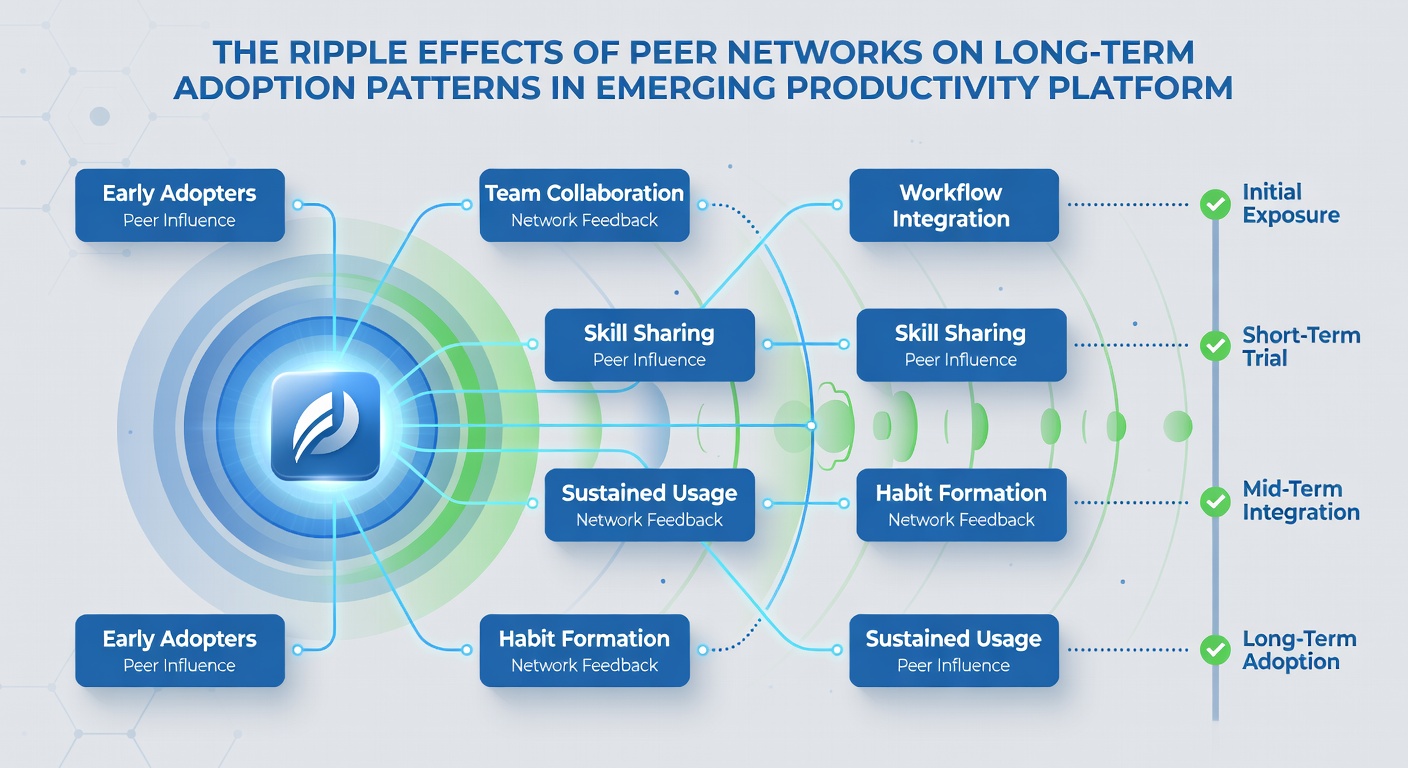
Productivity platforms such as collaborative workspaces and task automation systems depend on accurate information sharing within peer groups to overcome initial skepticism. When users exchange detailed accounts of workflow improvements, adoption accelerates because potential users receive context-specific evidence rather than generic claims. Studies compiled by academic institutions across North America and Europe reveal that dense peer clusters, where multiple members already use a platform, produce faster diffusion rates than sparse networks with isolated early adopters. In these denser groups the probability of continued platform engagement rises because ongoing discussions address emerging technical hurdles before they escalate into widespread abandonment.
Observers note that weak ties, such as occasional interactions in professional forums, still contribute by introducing platforms to new segments. These peripheral connections often serve as bridges that carry awareness beyond immediate workplace circles, yet sustained usage hinges more heavily on strong ties that provide repeated reinforcement. Canadian government statistical releases from 2024 documented similar patterns in small and medium enterprises, where peer referrals accounted for over forty percent of platform selections that remained active beyond the first year.
Short-Term versus Long-Term Adoption Dynamics
Initial uptake frequently occurs through visibility in peer conversations, while endurance depends on whether those conversations evolve into shared problem-solving sessions. Platforms that facilitate group-level customization and collective troubleshooting retain users at higher rates because the network itself becomes invested in platform success. Research tracking cohorts in the technology and finance sectors indicates that teams maintaining regular peer review sessions around platform metrics demonstrate lower churn after eighteen months. Conversely, platforms adopted primarily through individual experimentation show steeper drop-off curves once novelty fades.
Empirical Patterns Observed in 2025-2026
Longitudinal analyses released in May 2026 by cross-regional research consortia highlighted consistent ripple effects across multiple productivity categories. Adoption curves for new automation platforms steepened sharply within organizations that contained at least three interconnected peer advocates, and retention figures remained elevated when those advocates continued exchanging usage data quarterly. European Union digital economy monitoring reports from the same period corroborated these findings, noting that platforms embedded in existing communication channels achieved twenty-five percent higher sustained usage metrics than those introduced through top-down mandates alone.
What's interesting emerges when networks span organizational boundaries. Cross-company peer exchanges, often hosted on industry association platforms, introduce comparative benchmarks that help users evaluate whether a platform scales with growing team sizes. Australian Bureau of Statistics data released in early 2026 showed that firms participating in such external peer forums reported longer platform lifespans, particularly when participants shared anonymized performance indicators. These exchanges reduce perceived risk and allow organizations to anticipate integration requirements before committing resources.
Feedback Loops and Platform Evolution
Peer networks do not merely transmit static information but generate iterative feedback that shapes platform development roadmaps. Developers who monitor community discussions identify recurring friction points and release targeted updates, which in turn strengthens user loyalty. Evidence from industry tracking studies demonstrates that platforms incorporating peer-suggested features within six months of launch experience slower declines in active accounts. This cycle becomes self-reinforcing because satisfied users remain within the network and continue supplying refinements.
Yet not every network produces positive outcomes. When peer groups circulate incomplete or outdated information about platform limitations, adoption can stall even among technically capable teams. Mitigation occurs through the presence of knowledgeable moderators or designated power users who verify claims against official documentation. Organizations that designate such roles within their peer structures report more stable long-term patterns, according to aggregated findings from multiple academic working papers published in 2025.
Conclusion
Peer networks exert measurable influence on both the velocity and durability of productivity platform adoption, and the strength of that influence scales with network density and the quality of shared information. Data collected through 2026 continues to show that sustained engagement arises when peer interactions evolve from initial recommendations into ongoing collaborative troubleshooting and feature refinement. Organizations seeking durable implementation therefore benefit from understanding existing network structures before introducing new platforms, allowing those structures to amplify rather than impede long-term usage patterns.